
Every home settles. Most foundation cracks are not structural problems. They are the natural result of concrete curing, soil compaction, and a house adjusting to its environment over the first several years of its life.
But Alabama is different. Jefferson, Shelby, Cullman, and Talladega counties sit on expansive red clay soil. This soil swells when it absorbs water and shrinks as it dries. Alabama averages over 54 inches of rainfall per year, which means this expansion and contraction cycle repeats continuously, season after season. That movement puts sustained, uneven pressure on foundations in ways that sandy or loam soils in other regions do not.
What is a harmless shrinkage crack in Kansas is a
warning sign in Alabama. This guide explains how to tell the difference.
What Normal Settling Looks Like
Normal settling occurs as a home compresses into the soil beneath it over its first few years. Concrete also shrinks slightly as it cures. Both processes produce cracks, and most of them are benign.
Characteristics of normal settling cracks:
Thin and hairline. Normal cracks are typically less than 1/16 inch wide — narrower than a credit card edge. You can see them but not fit a finger or a coin into them.
Vertical or slightly diagonal. These cracks run up and down or at a slight angle, following the path of least resistance as concrete cures and the house adjusts.
Stable. A settling crack does not grow. If you mark the ends with a pencil and check it three months later, the marks should still align with the crack tips.
Dry. Normal settling cracks do not allow water through. There is no staining, efflorescence, or dampness around them.
Cosmetic.
Hairline surface cracks on interior drywall above doors and windows are a classic sign of normal first-year settling. These are in the drywall, not the foundation.
What Alabama's Clay Soil Changes
Alabama red clay is classified as an expansive soil. Its clay mineral content — primarily kaolinite and montmorillonite — absorbs water and expands volumetrically. When rainfall soaks the soil around your foundation, the clay swells and pushes inward against the wall. When dry spells shrink the clay, it pulls away from the foundation, leaving gaps that fill with water during the next rain cycle.
Over years and decades, this repeated load creates conditions that settling alone does not produce. Alabama homes experience:
Higher rates of horizontal cracking, which indicates lateral pressure from soil pushing against the wall rather than simple vertical settling.
Foundation wall displacement, where sections of the wall lean inward over time under sustained soil load.
Floor slab movement, where Alabama's clay soil heaves upward under slabs during wet periods and drops during dry spells, causing uneven or cracked floors.
Differential settling, where one section of the foundation sinks more than another due to inconsistent moisture content in the soil around the perimeter.
This is why foundation cracks in Alabama require a different evaluation standard than the same cracks in other regions.
Foundation Crack Types: What Each One Means
Hairline cracks (less than 1/16 inch wide) Typical cause: concrete curing or normal first-year settling. Monitor for growth. No immediate action needed unless water is entering or the crack grows wider than 1/8 inch.
Vertical cracks (run straight up and down) Typical cause: differential settling or concrete shrinkage. Common in poured concrete walls. Vertical cracks are generally lower severity than horizontal cracks. The concern is whether they are widening over time and whether they allow water entry.
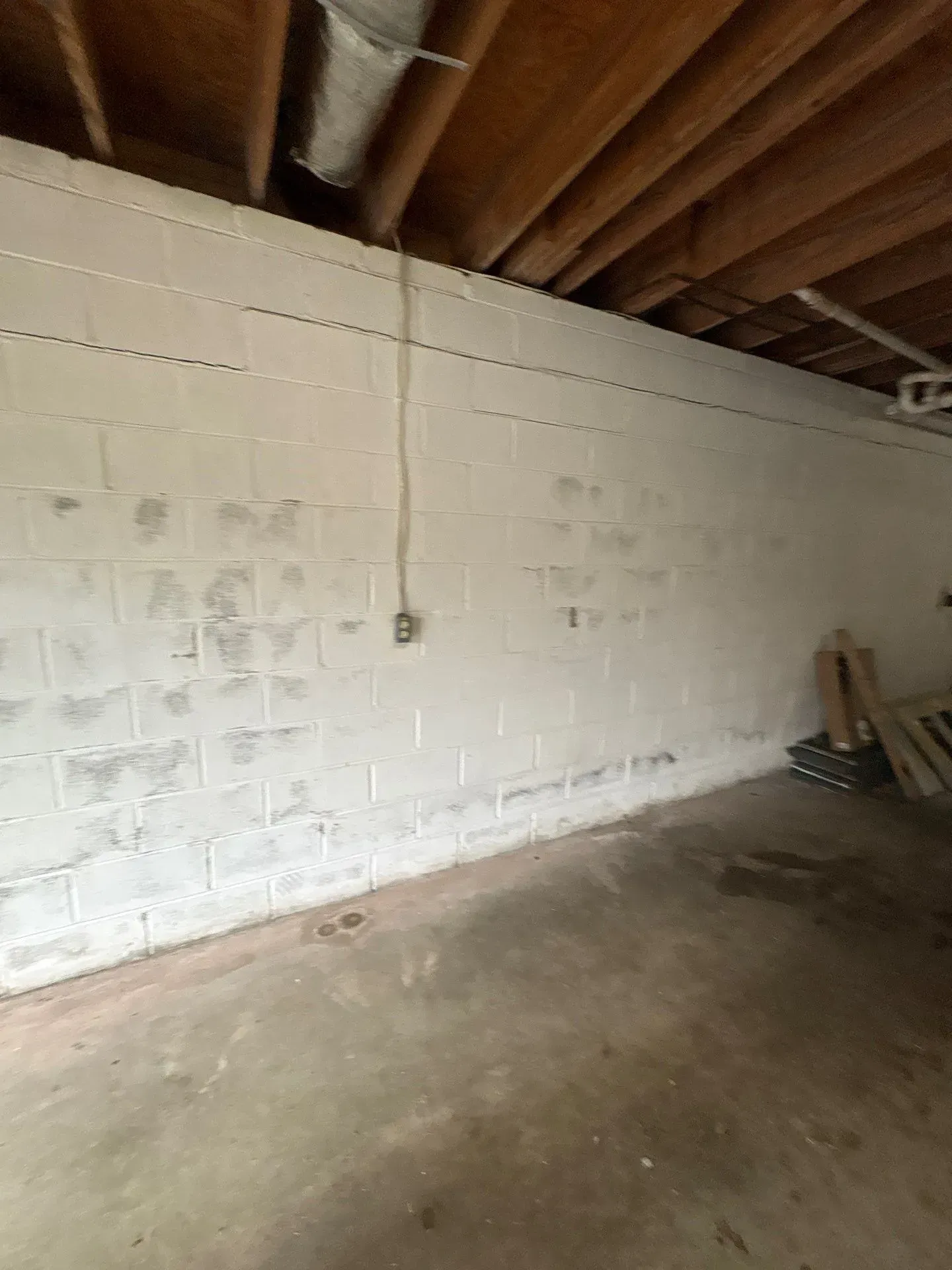
Diagonal or stair-step cracks Typical cause: differential settling in concrete block walls. Stair-step cracks follow the mortar joints between blocks. They indicate one section of the foundation is sinking or shifting more than another. In Alabama clay soil, this is often caused by uneven moisture content around the perimeter - one side of the foundation is wetter than the other.
Horizontal cracks Highest severity. Horizontal cracks in a foundation wall indicate lateral pressure from the soil outside. In Alabama, this is most often hydrostatic pressure from saturated red clay bearing against the wall face. Horizontal cracking means the soil load is exceeding the wall's design capacity. This requires professional evaluation immediately. Left unaddressed, horizontal cracks progress to wall bowing, displacement, and structural failure.
Cracks with displacement (one side higher than the other) Any crack where the two sides are at different heights - not just separated - indicates the foundation is moving in multiple directions. This is a structural signal regardless of crack width.
Cracks wider than 1/4 inch Width alone makes a crack a priority. At 1/4 inch or wider, you can see daylight through many cracks, and water entry during any storm event is likely.
Warning Signs That Go Beyond the Crack Itself
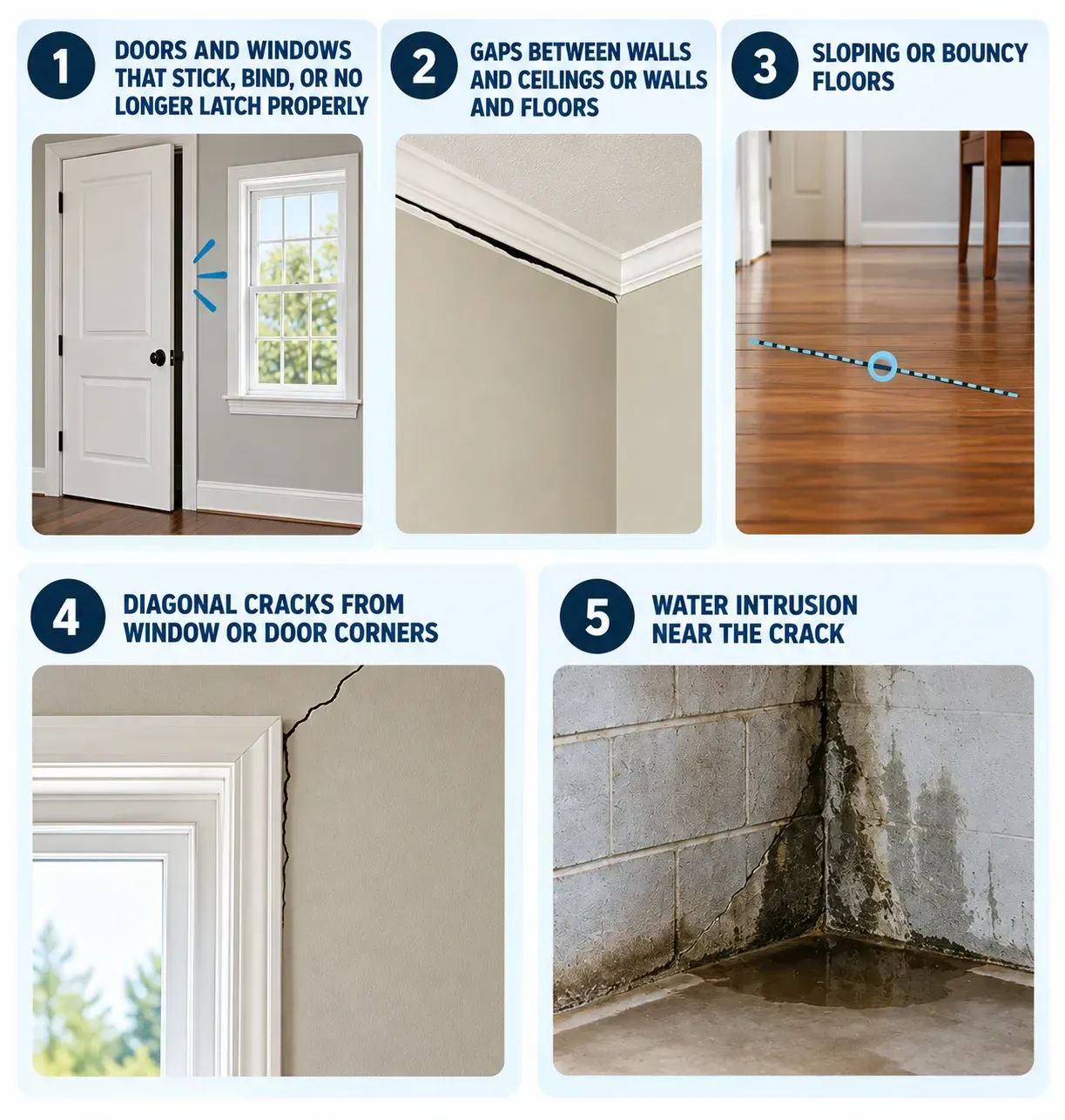
A single crack evaluated in isolation misses the full picture. Structural foundation problems almost always show up in multiple places throughout the home. Look for these symptoms alongside any crack you find:
Doors and windows that stick, bind, or no longer latch properly. Foundation movement shifts door and window frames out of square. This shows up in the same seasonal pattern as heavy rains in Alabama's clay soil - worse in wet weather, slightly better in dry spells.
Gaps between walls and ceilings or walls and floors. Where structural members are separating, something beneath them has moved.
Sloping or bouncy floors. In Alabama homes on clay soil, floor movement - especially toward the center of the home - can indicate heaving from below.
Diagonal cracks spreading from window corners or door corners in interior drywall.
Some surface cracking is normal. Cracks that are widening, spreading, or appearing in rooms that were previously crack-free are worth investigating.
Water intrusion near the crack. Any
crack that allows water entry after rain is creating secondary damage from moisture, regardless of structural severity.
Two or more of these symptoms together - alongside a crack of any width- is a strong signal that a professional evaluation is needed.
The Right Response by Crack Type
Monitor it yourself: Hairline vertical cracks in poured concrete walls with no water entry and no companion symptoms. Mark the ends, check in 90 days.
Get a professional opinion: Any crack wider than 1/8 inch, any crack with water entry, any crack accompanied by doors sticking or floors sloping.
Call today: Horizontal cracks of any width, cracks with displacement, any crack that has visibly grown since you first noticed it.
H2O Waterproofing provides free
foundation inspections throughout Alabama. A trained technician will document crack locations, measure widths, assess companion symptoms, and recommend whether monitoring,
waterproofing, or structural stabilization is needed. There is no charge for the inspection and no obligation.
Call (205) 956-2426 to get your foundation checked before a small crack becomes a big repair.
Foundation Repair Options in Alabama
When a crack requires more than monitoring, the repair approach depends on the type and source of movement.
Crack injection: Epoxy or polyurethane foam injected into vertical and diagonal cracks to seal water entry and stabilize the crack against further movement. This does not address structural movement but prevents water infiltration and limits further deterioration.
Carbon fiber straps: Installed horizontally across bowing or horizontally cracked walls to arrest inward movement. Carbon fiber does not push the wall back to original position but stops further displacement.
Wall anchors: Steel anchors driven through the foundation wall and into the soil outside, connecting to buried anchor plates. Over time, anchors can be tightened to gradually restore wall position.
Piering and underpinning: For foundations with significant settlement, steel piers are driven below the unstable clay layer to bedrock or load-bearing soil, and the foundation is lifted and stabilized.
H2O Waterproofing documents the correct repair approach during the free inspection based on what is actually causing the movement, not a one-size approach.
Frequently Asked Questions
Are all foundation cracks in Alabama serious?
No. Hairline vertical cracks from concrete curing or first-year settling are common and not structural problems. The concern in Alabama is that the clay soil creates conditions where non-structural cracks can develop into structural ones over time if the underlying soil pressure is not addressed. Any crack wider than 1/8 inch, any horizontal crack, or any crack with water entry deserves a professional evaluation.
How do I know if a crack is getting worse?
Mark both ends of the crack with a pencil line and the date. Check it every 30 to 60 days. A crack that is growing at either end or widening in the middle is active. A stable crack that has not changed in 6 months is likely a one-time settling event.
Does homeowners insurance cover foundation cracks in Alabama?
Standard homeowners insurance in Alabama does not cover foundation movement caused by soil settling, expansive clay, or hydrostatic pressure. These are classified as earth movement or gradual damage, which are standard exclusions. Sudden and accidental structural damage from events like a vehicle impact may be covered; your insurance agent confirms specifics.
How much does foundation repair cost in Alabama?
Crack injection runs $500 to $1,500 per crack depending on length and material. Carbon fiber straps typically run $1,500 to $3,500 per wall section. Full wall anchor systems run $5,000 to $12,000. Piering for significant settlement runs $15,000 to $30,000 or more depending on the number of piers required. H2O provides free, itemized estimates before any work is contracted.
Can a foundation crack cause water intrusion?
Yes. Any crack that extends through the full thickness of the foundation wall allows water to enter under hydrostatic pressure. Alabama's sustained rainfall and clay soil create conditions where pressure builds against foundation walls for days after a storm. A crack that appears dry in normal conditions often leaks during heavy rain events.
Is foundation repair urgent, or can I wait?
It depends entirely on the crack type. Horizontal cracks indicating lateral wall pressure should not be deferred - they worsen with each wet-dry cycle, and repair becomes significantly more expensive as displacement increases. Monitoring stable hairline cracks for 90 days is appropriate. If you are not certain which category your crack falls into, schedule a free inspection. H2O can tell you in a single visit.
H2O Waterproofing Serves Alabama Homeowners
H2O Waterproofing has assessed and repaired foundation cracks across Alabama since 2003. BBB A+ rated. Free inspections, written estimates, fully transferable lifetime warranties on waterproofing systems.
Call (205) 956-2426
to schedule your
free foundation inspection.
Search Post
Recent Posts


Share post